ROAS vs Profit: Why a High ROAS Doesn't Always Mean You're Profitable
A strong ROAS can make a campaign look successful while the business is barely profitable—or even losing money. Learn the difference between ROAS and profit, how to calculate both, and which costs marketers should consider before scaling.
A campaign generates $10,000 in revenue from $2,500 in advertising spend.
That’s a 4.0 ROAS.
At first glance, it sounds successful.
But how much money did the business actually make?
You can’t answer that question from ROAS alone.
Product costs, transaction fees, shipping, discounts and other variable costs can dramatically change the economics behind the same advertising result.
That’s why marketers and e-commerce operators need to understand the difference between ROAS and profit before deciding whether to scale a campaign.
What Is ROAS?
ROAS stands for Return on Ad Spend.
It measures how much revenue your advertising generates relative to the amount spent on advertising.
The basic formula is:
For example:
- Revenue: $10,000
- Ad spend: $2,500
ROAS:
That means the campaign generated $4 in revenue for every $1 spent on advertising.
ROAS is useful because it helps marketers compare advertising efficiency.
But there’s an important limitation:
ROAS measures revenue—not profit.
What Is Profit?
Profit looks beyond advertising spend and considers the costs required to generate the sale.
A simplified profitability calculation might look like:
Those other costs can include things such as:
- Cost of goods sold
- Shipping or fulfillment
- Payment processing fees
- Marketplace/platform fees
- Discounts
- Other variable costs associated with orders
Exactly which costs matter depends on the business model.
This is why two businesses generating the same ROAS can have completely different profitability.
Example: When a 4X ROAS Isn’t as Good as It Looks
Consider this hypothetical e-commerce campaign.
Revenue: $10,000
Ad spend: $2,500
ROAS:
Now suppose the business also has:
Product costs: $4,000
Shipping and fulfillment: $1,000
Payment/platform fees: $500
The economics become:
The advertising dashboard still reports a 4.0 ROAS.
But the business keeps far less than the $7,500 difference between revenue and ad spend.
That’s the distinction between advertising efficiency and business profitability.
Can You Have a High ROAS and Still Lose Money?
Yes.
Imagine another business generates:
$5,000 revenue from $1,000 ad spend.
That’s a 5.0 ROAS.
It sounds excellent.
But suppose producing and fulfilling those orders costs $4,300.
The calculation becomes:
The campaign generated five times its advertising spend in revenue while still producing a loss under this simplified scenario.
That’s why asking:
“What’s our ROAS?”
isn’t enough.
The better question is:
“At this ROAS, are we actually profitable?”
Why the Same ROAS Means Different Things for Different Businesses
There isn’t one universally profitable ROAS.
Consider two companies.
Business A
Selling price: $100
Variable cost before advertising: $25
Business B
Selling price: $100
Variable cost before advertising: $70
Both businesses could report identical revenue and identical advertising spend.
But Business A has substantially more room to pay for customer acquisition.
Business B requires much stronger advertising efficiency to remain profitable.
This is why statements such as:
“A 3X ROAS is good.”
can be misleading without context.
A good ROAS is one that works with your margins and economics.
What Is Break-Even ROAS?
Break-even ROAS is the approximate advertising efficiency at which revenue covers the relevant costs included in your calculation.
Above that point, additional revenue may contribute toward profit.
Below it, the campaign may lose money.
Understanding break-even economics gives marketers a more useful benchmark than choosing an arbitrary ROAS target.
Instead of saying:
“We need a 4X ROAS because 4X sounds good.”
you can ask:
“What ROAS does our business actually require to break even?”
That changes how advertising decisions are made.
For the formula and margin examples, read how to calculate break-even ROAS.
ROAS vs ROI
ROAS and ROI are also frequently confused.
ROAS focuses specifically on advertising efficiency:
ROI, depending on how a business defines and calculates it, generally looks more broadly at the return relative to the investment or costs involved.
ROAS can therefore be strong while overall returns remain weak.
For campaign analysis, it helps to think about the metrics as answering different questions:
- ROAS: How efficiently did advertising generate revenue?
- Profit: How much money remained after the costs included in the analysis?
Neither metric needs to replace the other.
They become more useful when viewed together.
Metrics to Review Before Scaling an Ad Campaign
Before increasing advertising spend, look beyond one dashboard number.
Useful metrics and inputs may include:
- Revenue
- Advertising spend
- ROAS
- Cost per acquisition
- Conversion rate
- Product or service costs
- Variable fulfillment costs
- Transaction/platform fees
- Contribution or profit per order
- Customer acquisition cost
- Customer lifetime value, when appropriate
Not every business needs every metric.
The goal is to understand enough of the economics to know what happens when advertising spend increases.
Why This Matters When Scaling
Imagine a campaign generates profitable sales at $100 per day.
Increasing the advertising budget doesn’t guarantee that the same economics will continue.
Acquisition costs can change.
Conversion rates can change.
Audience composition can change.
Margins can also change if scaling introduces different fulfillment or promotional costs.
That means scaling decisions shouldn’t rely on ROAS alone.
Marketers should continually evaluate advertising performance against the underlying economics of the business.
Calculate Campaign Profitability With ProfitKit
For the full revenue-and-cost walkthrough, learn how to calculate ad campaign profitability.
If you’re evaluating a campaign, you can use ProfitKit’s Campaign Profit Calculator to analyze the relevant campaign numbers supported by the tool.
Instead of looking at advertising efficiency in isolation, use your actual inputs to understand the economics behind the campaign.
Use the Campaign Profit Calculator →
The Bottom Line
ROAS is valuable.
But ROAS is not profit.
A high ROAS tells you that advertising generated revenue efficiently relative to ad spend. It doesn’t tell you how much money remained after the other costs required to generate those sales.
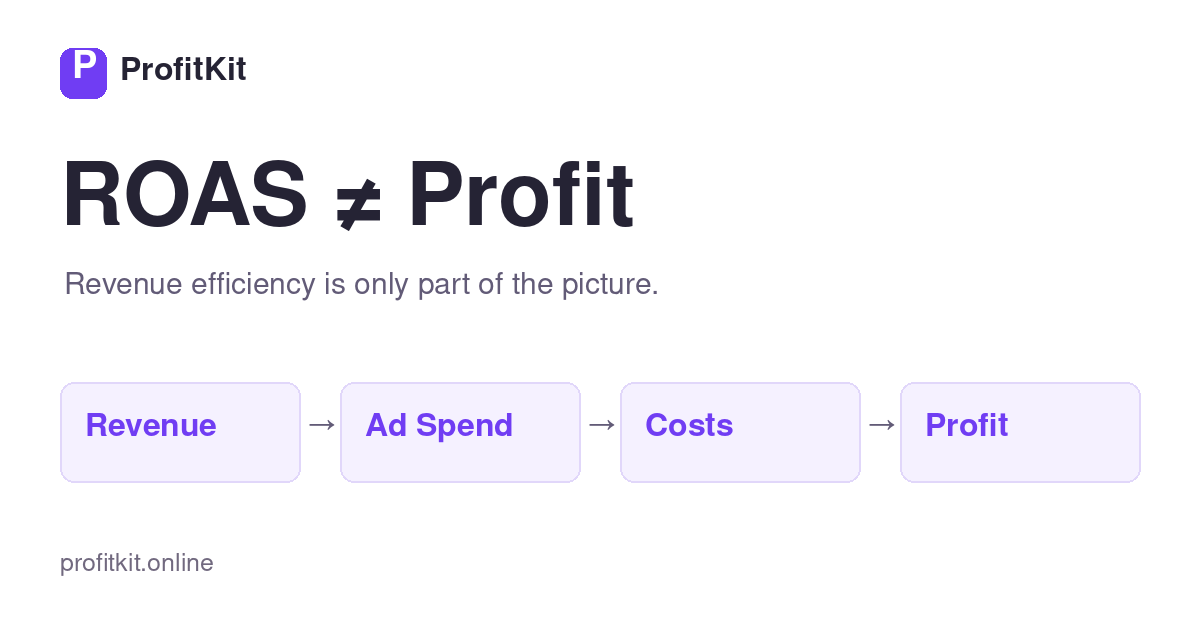
The strongest marketing decisions come from connecting:
Before scaling your next campaign, don’t stop at the ROAS number.
Know your numbers. Grow with confidence.